Discoveries · Art & Heritage · 13 November 2026
A Quiet Visit to St Martin’s Church in Bled: Frescoes, Architecture and History
Beyond Lake Bled’s island and castle, discover the neo-Gothic Church of St Martin, its frescoes, marble details and Plečnik-designed shrine, with respectful visit tips.
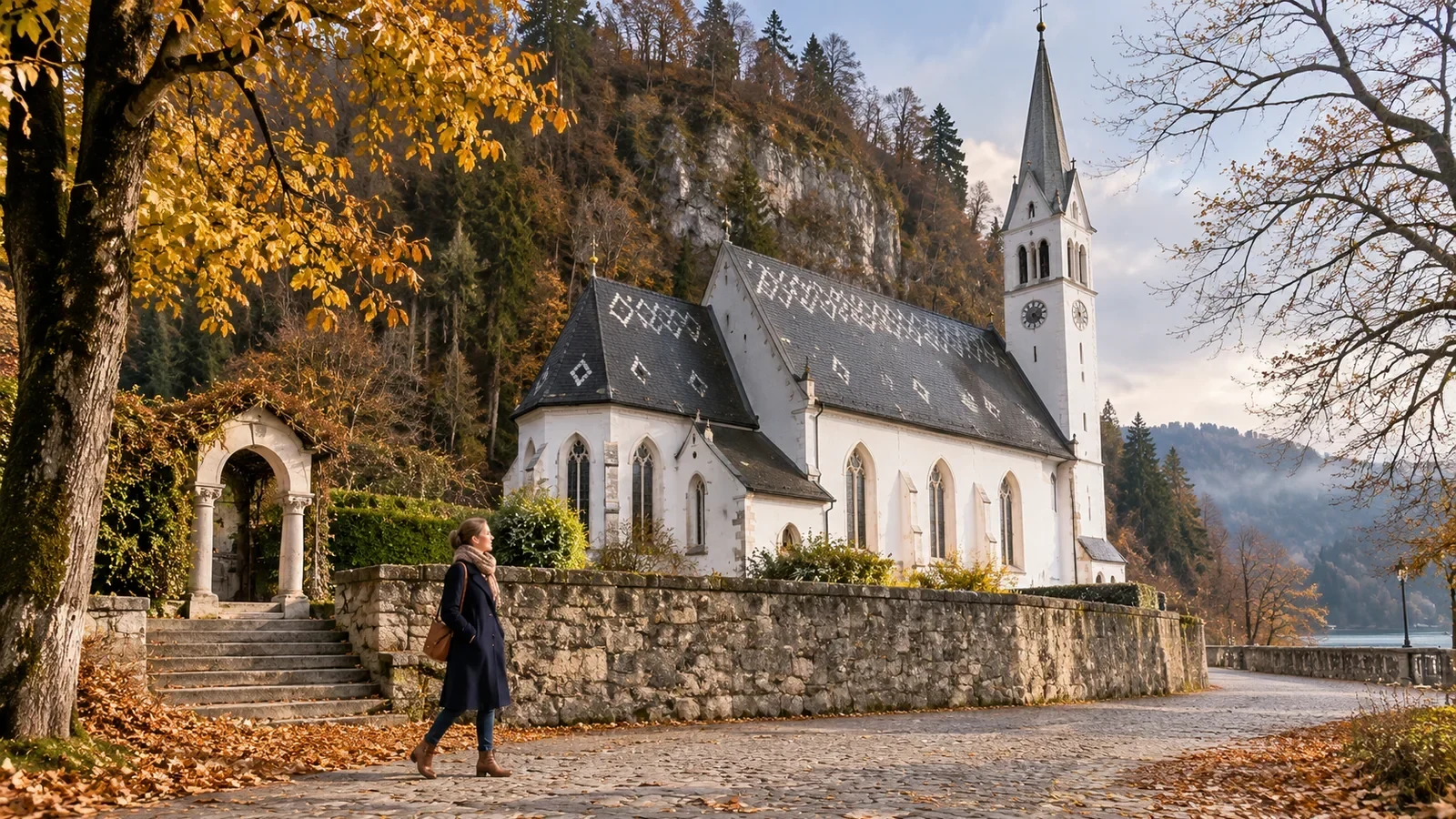
Bled has two very different churches that visitors sometimes mix up. The small church on the island is the one reached by boat, with the famous wishing bell. The Church of St Martin stands on the mainland, beneath the rocky hill associated with Bled Castle. It is the town’s parish church, a place of worship and one of Bled’s most rewarding stops for anyone interested in architecture, painting and the layers of local history.
The island naturally captures attention from across the water. St Martin’s asks for a different pace: look up at the tower, pause by the old walls and, if the church is open and not being used for a service, give its interior artwork a little more time than a hurried photograph.
A church site older than the building you see
A place of Christian worship existed here long before modern tourism. Tourism Bled traces the first chapel at this site to before the year 1000. The current church was completed in 1905, replacing a Gothic predecessor built in the fifteenth century. That is why a visit can feel like several historical eras standing side by side: an early sacred site, surviving medieval features and a comparatively recent neo-Gothic church.
Look first at the building as a whole rather than treating it only as a picturesque spire. The tall tower, pointed windows and steeply pitched roof reflect the vocabulary of neo-Gothic architecture. These are nineteenth- and early-twentieth-century interpretations of older Gothic forms, not proof that every stone of the present church is medieval.
Three names to notice inside
The design history has its own international character. The original plans drew on the work of Friedrich von Schmidt, whose architecture is also associated with Vienna’s City Hall. Architect Josip Vancaš made important changes, especially to the church’s interior.
Janez Vurnik, an artist and restorer from nearby Radovljica, contributed sculptural elements carved from Carrara marble. If the church is open to visitors, slow down enough to see the difference between carved material and painted surfaces. Their varied textures are part of the reason the interior deserves attention in its own right.
The wall paintings are by Slovenian painter Slavko Pengov. According to Tourism Bled, his fresco work here dates from 1932 to 1937. It helps to know those dates before entering: the pictures are neither remnants of a medieval chapel nor decorative inventions from a recent restoration, but part of the church’s twentieth-century artistic story.
A Plečnik detail outside
The exterior rewards a second look as well. Jože Plečnik designed the garden wayside shrine in front of the church before the Second World War. It is a much smaller intervention than the building itself, but it connects this place with a designer whose work transformed public spaces in Ljubljana and beyond.
Nearby, sections of the old church enclosure survive from the fifteenth century. Tourism Bled relates them to the history of Ottoman incursions. Seeing a defensive wall beside a working parish church is a reminder that sacred sites were also part of the lived and sometimes uncertain history of their surrounding communities.
One useful way to enjoy this stop is to notice a sequence of scales: the church against the cliff and trees, the details of the roof and windows, the modest shrine, the old masonry, then—if access permits—the marble and frescoes inside. You do not need to identify every artist’s technique to appreciate the contrast.
How to plan a respectful short visit
This is an active parish church, not a museum with guaranteed all-day tourist admission. The parish publishes worship information on its own website, and the Tourism Bled attraction page describes mass and occasional concerts. Neither source provides a reliable universal visiting window for every date. Check current parish announcements before making a special trip, and be ready for the doors to be closed for worship, maintenance or local activities.
If a service is in progress, keep the visit quiet or return later. Do not assume flash photography, filming or access to every part of the building is welcome. Modest clothing, low voices and respect for people praying will make the visit better for everyone. On damp autumn days, take extra care on steps and paved approaches; wet leaves and stone can be slippery. This is general seasonal advice, not a claim about current path or accessibility conditions.
Allow enough flexibility to enjoy the outside even when an interior visit is not possible. A short, unhurried stop is often more satisfying than trying to fit another fixed-time attraction between tickets, restaurant bookings and transport connections.
Pair it with another side of Bled
If you have already visited Bled Castle, this church offers a contrasting perspective: rather than another ticketed viewpoint, it is a place to notice what several generations of residents, artists and architects contributed to the town. If you have only seen the church on Bled Island, compare the two without assuming they share the same history, entrance arrangements or role in parish life.
For a longer cultural day, combine this visit with our separate guides to [Bled Castle in November](/journal/bled-castle-in-november-walk-hours-tickets-museum/) and the [boat journey to Bled Island](/journal/pletna-to-bled-island-in-november-practical-guide/). Those pages explain their respective experiences and practical arrangements; this church is worth treating as a destination in its own right.
There is also value in visiting with no schedule beyond a quiet look. In late autumn the light changes quickly, the trees thin out and architectural details often become easier to notice. A familiar postcard town can feel a little more personal when you make room for the smaller stories beside its celebrated lake.